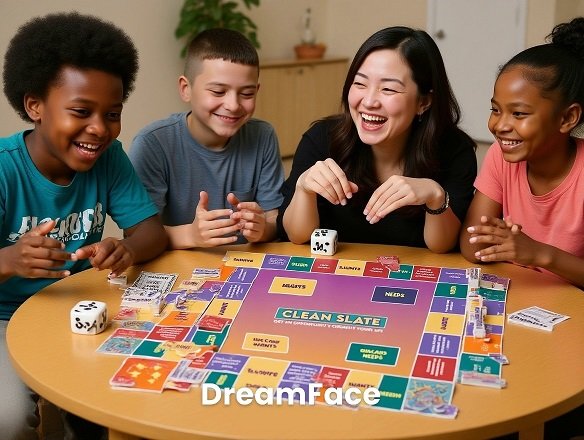
Clean Slate For Educators
Play Clean Slate online on Table Top Simulation
WHY TEACHERS LOVE IT
The Financial Literacy Tool Your Classroom Needs
Clean Slate isn’t just a game—it’s an experiential learning tool that teaches students about money management, decision-making, and real-life consequences in ways traditional lessons cannot.
Students don’t just learn about wants vs. needs. They experience them. They don’t just hear about budgeting. They live it. And the lessons stick.
BENEFITS
- Why Teachers Love Clean Slate
- Proven results in the classroom
BENEFIT 1
Aligns With Educational Standards
Description: Clean Slate supports financial literacy curriculum requirements and life skills education standards across multiple grade levels.
BENEFIT 2
Engages Even Reluctant Learners
Description: Students who zone out during lectures are fully engaged during gameplay. The competitive element keeps everyone involved.
BENEFIT 3
Creates “Aha” Moments
Description: Students have breakthrough realizations about money, choices, and consequences that they’ll remember for life.
BENEFIT 4
Sparks Meaningful Discussions
Description: The Goal/Redo system opens conversations about students’ futures and helps them think critically about their plans.
BENEFIT 5
Easy to Implement
Description: Clear rules, complete materials, and 60-minute gameplay fit perfectly into class periods.
BENEFIT 6
High Replay Value
Description: Every game plays differently. Students can play multiple times and have new experiences each time.
LEARNING OBJECTIVES
- What Students Will Learn
- Measurable outcomes for your curriculum
Financial Literacy Skills
Financial Literacy Skills Learned:
✅ Budgeting and money management
✅ Understanding income vs. expenses
✅ Distinguishing wants from needs
✅ Planning for unexpected costs
✅ Long-term financial consequences
✅ Goal-setting and prioritization
Life Skills Developed:
✅ Decision-making under pressure
✅ Cause and effect understanding
✅ Strategic thinking
✅ Delayed gratification
✅ Risk assessment
✅ Personal responsibility
IMPLEMENTATION OPTIONS
- How to Use Clean Slate in Your Classroom
- Flexible implementation for any schedule
OPTION 1 
- Full Class Activity
- Time Badge: 60-75 minutes
Description:
Divide class into groups of 4-6 students
Each group plays one complete game
Debrief as a class afterward
Best For: Financial literacy units, life skills classes, economics courses
OPTION 2 
- Rotation Station
- Multiple class periods
Description:
Set up Clean Slate as one learning station
Small groups rotate through gameplay
Other stations can include budgeting worksheets, career research, etc.
Best For: Integrating into broader curriculum units
OPTION 3 
- After-School Program
- Time Badge: Ongoing
Description:
Offer Clean Slate as an after-school club or activity
Students can play multiple rounds and track progress
Discuss strategies and outcomes
Best For: Extended learning, mentorship programs, club activities
OPTION 4 
- Competition Format
- Time Badge: Tournament-style, multiple sessions
Description:
Students play elimination rounds
Winners advance to championship game
Award prizes for best financial management
Best For: Creating excitement, end-of-unit culmination, school-wide events
SAMPLE LESSON PLAN
- Ready-to-Use Lesson Plan
- Complete 75-minute lesson structure
BEFORE GAMEPLAY
- Time Badge: 10 minutes
- BEFORE GAMEPLAY
Learning Objectives: Students will be able to:
Distinguish between wants and needs
Understand basic income and expense management
Make financial decisions with consequences
Hook Activity: Ask students: “If you had $5,000 right now, what would you do with it?”
List responses on board. Identify which are wants vs. needs.
Introduction: “Today we’re going to experience what it’s like to manage money as an 18-year-old starting out in life. Every choice you make will affect your outcome.”
Goal/Redo Form: Have all students fill out the Goals section (even if over 18, they can do goals). Share a few with the class.
DURING GAMEPLAY
Time Badge: 60 minutes
Group Setup:
Divide into groups of 4-6
Assign or let students choose roles (Banker, etc.)
Distribute materials
Teacher Role:
Circulate between groups
Listen for teaching moments
Ask guiding questions: “Why did you make that choice?” “What might happen if…?”
Note interesting situations to discuss later
Observation Points:
Which students prioritize needs?
Who goes broke first and why?
What strategies emerge?
How do students react to setbacks?
AFTER GAMEPLAY
Time Badge: 15 minutes
Debrief Questions:
- Who won? What strategy did you use?
- Who went broke? What happened?
- What surprised you about the game?
- What was the hardest choice you had to make?
- Did your goals from the beginning change after playing?
- How is this game like real life? How is it different?
- What did you learn about wants vs. needs?
- If you could play again, what would you do differently?
- What advice would you give someone starting out at 18?
Reflection Assignment: Have students write:
3 things they learned
2 strategies for real-life money management
1 goal they have for their financial future
Extension Activity: Create a personal budget based on realistic income for their intended career.
CURRICULUM ALIGNMENT
Standards Alignment
Clean Slate supports your curriculum requirements
STANDARDS 1
National Standards for Financial Literacy
Alignment:
- Earning Income
- Spending and Saving
- Managing Money
- Financial Decision Making
STANDARDS 2
Common Core Standards Alignment:
- Critical thinking and problem-solving
- Decision-making skills
- Mathematical reasoning (money management)
TANDARDS 3
21st Century Skills Alignment:
- Financial literacy
- Life and career skills
- Critical thinking and problem-solving
STANDARDS 4
State-Specific Standards
Description: Contact your state for alignment documentation for your state’s requirements.
FREE RESOURCES
Teachers can discuss lesson plans and the progress of the student.
